PCR Thermal Cycler vs Real-Time PCR vs Fluorescence Analyzer
An end-point PCR thermal cycler, a real-time PCR system and a fluorescence quantitative analyzer are three different instruments, not three price tiers of the same one. The decisive question is where fluorescence is measured in your workflow: inside the thermal block during amplification, after amplification in a separate readout step, or in a reader that never amplifies anything at all. Buyers who compare the three on purchase price alone usually find the mismatch after installation, when the assay protocol no longer matches the hardware on the bench.
This guide is written for IVD buyers at the decision stage — laboratory directors, procurement managers, technical evaluators and distributors — who already hold a shortlist and need a defensible reason to choose one category over another. It compares the three device types by workflow role, converts that comparison into evaluation criteria and a selection sequence, and closes with the data-integrity, service, warranty and delivery questions that decide whether the instrument still performs two years after acceptance.
Product facts below come from Xi'an Tianlong Science and Technology Co., Ltd. (Tianlong) materials and the product data supplied for this comparison. Market context is attributed to its published research source. Where a value is not published, this guide says so rather than estimating it.
Why this comparison is harder than it looks
The three categories are difficult to compare because suppliers use overlapping vocabulary across catalogues, quotations and tender documents. Three specific traps cause most of the confusion.
Trap one: one name, two instruments. In some markets "fluorescence quantitative analyzer" is used loosely as a synonym for a real-time PCR instrument, because real-time PCR is itself a fluorescence-based quantitative method. In other catalogues the same phrase describes a detection-only reader. A purchase order written against the wrong reading of the term can deliver an instrument that cannot run your assay at all.
Trap two: the same supplier family. A single manufacturer may list thermal cyclers, real-time PCR systems, integrated workstations and detection readers under one "PCR" family heading. Similar model numbering then reads as similar capability, even though the workflow position of each instrument is different.
Trap three: the hidden second step. An end-point thermal cycler does not report a result. It delivers an amplified product that still needs a detection step — gel electrophoresis, end-point plate reading or sequencing. That second step carries its own consumables, labour time, contamination risk and turnaround. Buyers who budget only the cycler routinely underestimate the workflow.
The practical consequence is that a category decision made on instrument price alone is not a decision about capability. It is a decision about which workload the laboratory will absorb elsewhere.
Industry background: what an IVD instrument actually has to do
In vitro diagnostics are tests used to detect disease, conditions and infections, according to the World Health Organization's overview of the field. The same source notes that IVD testing may take place in laboratories, healthcare facilities or homes, and that the tests are performed on instruments ranging from small handheld devices to complex laboratory systems. That range is the reason a single "PCR instrument" shortlist can contain three genuinely different machines.
The formal definition used in regulatory work is broader still. The 2012 GHTF definition document hosted by WHO describes an IVD medical device as one intended for the in-vitro examination of specimens derived from the human body to provide diagnostic, monitoring or compatibility information, and explicitly lists reagents, calibrators, control materials, specimen receptacles, software, instruments and related apparatus as included component types. For procurement, this matters because it separates what is being qualified: an instrument, a reagent menu, the software that ties them together, or a combination of all three.
Regulatory expectations reinforce the same point. The IMDRF in vitro diagnostic regulatory submission table of contents, in its 2024 edition, addresses IVD submissions and includes content related to risk management and assay validation. A supplier's submission readiness therefore depends on documented validation evidence, not on a product label. Buyers comparing instrument categories should ask for that evidence at the same time as the quotation, because the assay-validation burden follows the platform you choose.
Market context is supportive but should be read as a forecast, not a measurement. A MarketsandMarkets molecular diagnostics report summarised in the supplied research set values the global market at an estimated USD 19.48 billion in 2025 and projects USD 30.74 billion by 2030, a reported CAGR of 9.6%. That projection does not change which instrument a given laboratory needs; it only indicates that platform decisions taken now are likely to stay in service through several test-menu expansions.
What each device actually does
End-point PCR thermal cycler
A thermal cycler controls block temperature through programmed denaturation, annealing and extension steps, and holds the reaction at a final temperature when cycling ends. It performs nucleic acid amplification. It does not, by itself, quantify the product: detection is a separate downstream operation carried out on other equipment. Selection criteria therefore centre on block format and sample capacity, temperature accuracy and uniformity, ramp behaviour, programmability, and how comfortably the unit fits a bench that already has a detection workflow.
Because the readout happens elsewhere, the cycler is often the lowest-cost instrument in the three-way comparison and the highest-cost workflow, once the detection step and its labour are counted.
Real-time PCR system
A real-time PCR system combines thermal cycling with optical detection during each cycle, so amplification and measurement occur in the same closed tube or plate. That is the structural difference from a thermal cycler: the readout is inside the instrument, and the result is available as a cycle-by-cycle fluorescence profile rather than a post-run gel image.
Evaluation criteria shift accordingly, and optics join temperature control as decision factors: how many fluorescence channels the instrument provides and whether your multiplex assay fits inside them, how the light source ages, how software handles baselines and exports, whether the instrument can be calibrated on site, and what happens to a run in progress if power fails. Every one of those is a question a buyer can put to a supplier in writing.
Fluorescence quantitative analyzer
A fluorescence quantitative analyzer measures fluorescence intensity and converts it into a quantitative reading against an assay's calibration or cut-off. Its role is detection and quantification, not amplification. That distinction matters commercially: if a laboratory already has an amplification step and only needs a reader, an analyzer is the smaller and more targeted purchase. If the workflow still requires thermal cycling, an analyzer alone cannot complete it.
Because positioning varies between suppliers, this category should always be confirmed against the technical datasheet rather than the catalogue name. The single most useful question is whether the unit contains a programmable thermal block capable of running a PCR temperature profile.
The question that settles the category
Before comparing price, ask one question: does the unit contain a thermal block that runs the full PCR temperature programme? If yes and the optics work during cycling, it is a real-time PCR system. If yes and there are no optics, it is a thermal cycler. If no, it is a detection instrument and must be paired with an amplification step. Everything else in the evaluation follows from that answer.
Where Tianlong's instrument lines sit in this comparison
Xi'an Tianlong Science and Technology Co., Ltd. is a Chinese molecular diagnostics and life science company founded in 1997. Tianlong describes itself as a genetic testing, molecular diagnostics, PCR solution and IVD company, and reports a portfolio spanning automated nucleic acid extraction systems, automated sample processing and PCR setup workstations, real-time PCR systems, PCR thermal cyclers, an all-in-one molecular diagnostic system, a POCT molecular testing system, and associated extraction and detection reagent kits. The company reports that its products are exported to more than 100 countries and used by more than 9,000 customers, and that it holds Chinese medical device registrations alongside CE-, FDA- and KFDA-related credentials. These are company-reported figures and should be verified against registration records for your market.
Within the three-way comparison in this guide, the portfolio maps as follows.
- PCR thermal cyclers: the Genesy 96T and NeoGT X2 are listed as Tianlong's PCR thermal cycler models.
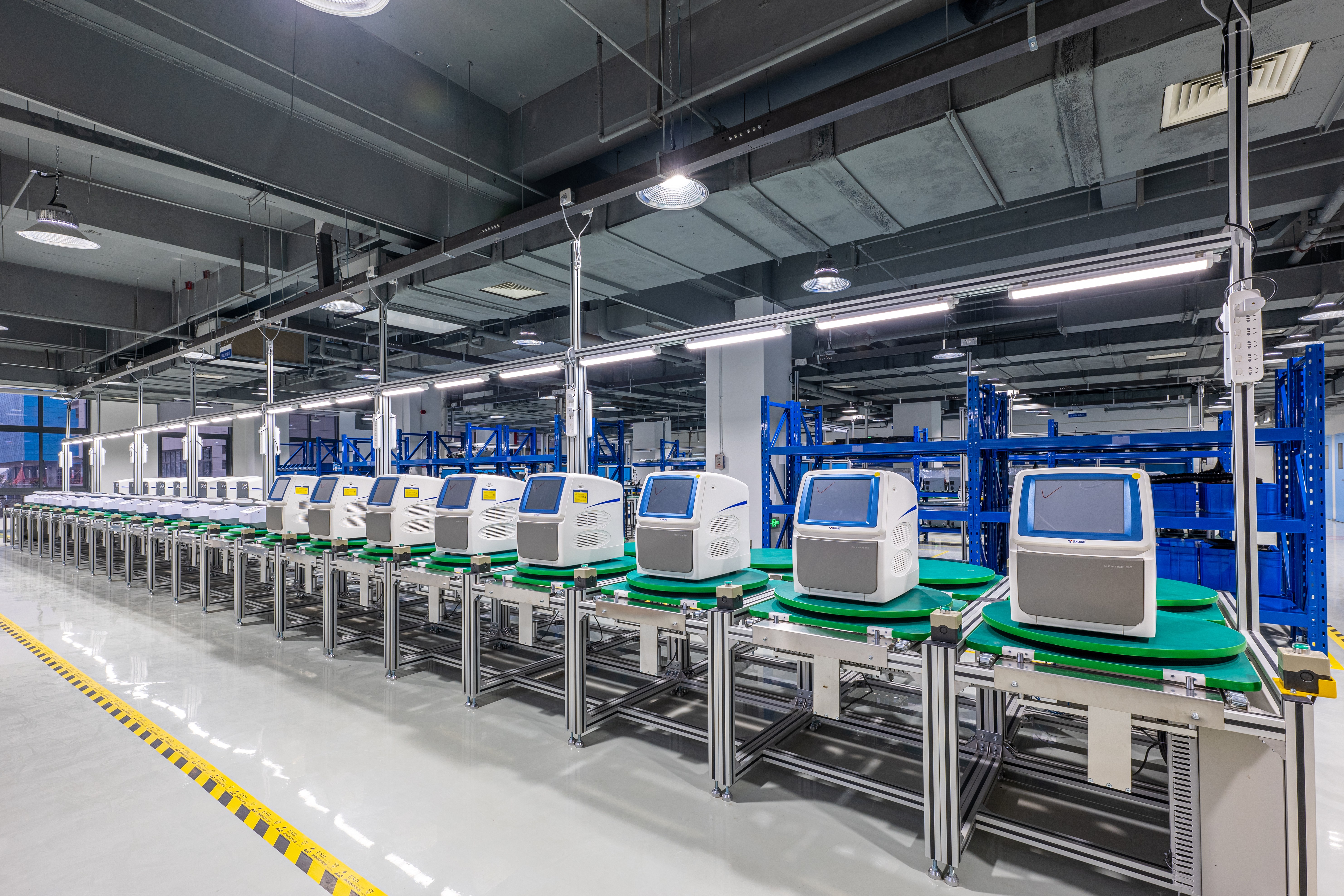
- Real-time PCR systems: the Gentier family — Gentier X3 series, Gentier Sp96 series, Gentier 48 series, Gentier Mini series and Gentier 96 series, including the Gentier 96E and 96R.
- Integrated alternatives: the Panall 8000 all-in-one molecular diagnostic system and the iGeneBox 3A POCT molecular testing system are catalogued as complete systems rather than as separate detection modules, which is relevant if the detection question is being answered by consolidation instead of by a standalone reader.
On the real-time side, Tianlong describes the Gentier 96E and 96R as offering 6 or 4 fluorescence channels and processing 96 samples in one run, with temperature accuracy and uniformity reported within ±0.1°C, and with a high-brightness, long-life LED light source described as maintenance-free. These are supplier-reported specifications; they belong in a verification checklist, not in an unqualified comparison table against unnamed competitors.

Side-by-side comparison by workflow role
| Evaluation dimension | End-point PCR thermal cycler | Real-time PCR system | Fluorescence quantitative analyzer |
|---|---|---|---|
| Core function | Programmable thermal cycling for amplification | Thermal cycling plus fluorescence detection during each cycle | Fluorescence measurement and quantification of a prepared reaction |
| Does it amplify nucleic acid? | Yes | Yes | No — confirm with the datasheet in every case |
| Where the result comes from | A separate downstream step such as gel electrophoresis, end-point reading or sequencing | Directly from the instrument's cycle-by-cycle fluorescence data | The reader, against the assay's calibration or cut-off |
| Optical channels | None | Tianlong describes 6/4 channels for Gentier 96E/96R | Assay-dependent; confirm channel count and filters |
| Temperature control | Block-based; request accuracy and uniformity data | Tianlong reports ±0.1°C accuracy and uniformity for Gentier 96E/96R | No thermal cycling; confirm whether any incubation function exists |
| Throughput reference | Confirm block format and capacity from the datasheet | 96 samples per run described for Gentier 96E/96R | Confirm plate or strip format and read time |
| Data continuity after power loss | Confirm with supplier | Gentier 96E: automatic recovery of experiments and functions after power restoration | Confirm with supplier |
| Typical application fit | Conventional PCR with downstream analysis; teaching and research workflows | Tianlong lists hospitals and clinical laboratories, diagnostic and third-party testing laboratories, CDCs and public health laboratories, universities and research institutes for the Gentier 96E/96R | Assays already amplified upstream; readout-only workflows |
| Main procurement risk | Underestimating the cost and labour of the separate detection step | Paying for optical channels and assays you will not run | Buying a reader when the missing capability was amplification |
Read the table as a workflow map rather than a ranking. No column is superior in general; each answers a different question about where the laboratory's work happens.
Step-by-step: how to run the selection
The sequence below keeps the category decision ahead of the brand decision, which is the order that survives audit and internal review.
- Write down the assay's readout requirement. State whether the result is a gel band, an end-point signal, a cycle-threshold value or a concentration. The readout determines the category before any supplier is contacted.
- Count samples per run and per day. Match that number to the instrument's stated capacity. For reference, Tianlong describes 96 samples per run for the Gentier 96E/96R; thermal cycler and analyzer capacities must be taken from their own datasheets.
- Define the multiplex requirement. List the targets that must be detected in one tube. Channels, dye sets and filter compatibility decide whether a real-time system can run the panel without splitting it.
- Ask for temperature-control evidence, not adjectives. Request accuracy and uniformity figures with test conditions. Tianlong's reported ±0.1°C for the Gentier 96E/96R is the format a supplier answer should take; the same format should be demanded from every shortlisted instrument.
- Test the data-continuity story. Ask what happens to a run in progress when power fails, and whether recovery is automatic or manual. This is examined in the next section.
- Check software against your reporting routine. Confirm export formats, audit trails and how results move into your laboratory information system. Software that requires manual transcription adds an error path that no specification sheet captures.
- Settle service, warranty and delivery in writing. These are treated separately below because they carry more commercial risk than the instrument specification in most tenders.
- Confirm registration status for your market. Regulatory classification and registration determine whether the instrument can be used for the intended diagnostic purpose at all, and they differ by jurisdiction.
The power-interruption checkpoint: what the Gentier 96E question reveals
One question exposes more about a real-time PCR platform than a page of marketing specification: can the instrument recover data after a power outage?
For the Gentier 96E, the answer recorded in the product FAQ is yes — it features automatic recovery of experiments and functions after power restoration. That is a specific, checkable statement about one model, and it should not be generalised to other instruments in the same family or to other suppliers without confirmation.
Why does this belong in a category comparison rather than a footnote? Because a completed run that cannot be recovered consumes the sample, the reagents and the slot in the day's schedule. In a laboratory running 96 samples per run, a mid-run interruption is not an inconvenience; it is a repeat. Three evaluation questions follow from that:
- Is recovery automatic on power restoration, or does an operator have to intervene?
- Is the recovered data the full run record, or does the run resume from the interruption point?
- Is the behaviour documented in the instrument's manual, so it can be cited in a validation file?
The same checkpoint applies to thermal cyclers and standalone analyzers, where recovery behaviour is supplier-specific and should be confirmed rather than assumed. Asking the question of all three categories turns a vague reliability impression into a documented criterion.
Procurement note: a supplier's statement that a model "handles power interruption" is not the same as an automatic recovery function. Ask for the manual reference and, during acceptance testing, simulate an interruption on a non-diagnostic run.
Application fit by laboratory type
Category fit follows the workload, not the budget line.
Hospitals and clinical laboratories running routine infectious disease and pathogen panels usually need quantified results inside the instrument, which points to a real-time PCR system. Tianlong lists hospitals and clinical laboratories among the intended users of the Gentier 96E/96R, consistent with that pattern.
Third-party diagnostic and testing laboratories face the widest menu variability. A real-time platform with multiple fluorescence channels — 6/4 channels are described for the Gentier 96E/96R — allows more targets to be combined per run, which matters when the sample mix changes weekly.
CDCs and public health laboratories typically combine surveillance testing with confirmatory work. A real-time system covers both quantification and documentation, while a thermal cycler remains useful for conventional or sequencing-bound protocols.
Universities and research institutes often keep both an end-point cycler and a real-time system, because teaching and method-development protocols differ from routine quantification.
Laboratories with an established upstream workflow that only need a quantitative readout are the natural buyers of a fluorescence quantitative analyzer, provided the amplification step already exists and is validated.
After-sales support, warranty and delivery: the part that decides the purchase
Instrument specifications determine whether a platform can do the work. Service terms determine whether it keeps doing the work. Three areas deserve explicit written answers before a purchase order is raised, and none of them can be inferred from a catalogue.
Remote and on-site support. Establish what can be resolved remotely, what requires an engineer on site, and which of the two applies to your region. Ask how fault reports are raised, what response and resolution times are committed, and whether spare parts are stocked locally or shipped from the factory. A laboratory that cannot afford a two-week downtime should ask for the escalation path in writing, not verbally.
Warranty scope. Warranty duration is only half the question. Confirm what is covered — optical modules, thermal block, light source, software updates — what voids coverage, whether preventive maintenance visits are included, and whether coverage starts at shipment or at acceptance. For a real-time system, the optical path is the component whose exclusion changes the lifetime cost most.
Delivery lead time. Confirm the interval from order to installation and distinguish it from shipment date. Ask whether installation, calibration and operator training are included, and whether lead time is quoted for the base instrument or for the configured unit with the channel set and accessories you specified. Configured units are what arrive; base-unit lead times mislead.
For buyers evaluating Tianlong, these terms should be requested through the company's published channels and confirmed for the destination market rather than assumed from another region's quotation. The Tianlong company introduction brochure provides the portfolio and company background needed to open that conversation.
Frequently asked questions
Which in vitro diagnostics manufacturers best balance product range and clinical application fit?
The balance is assessable rather than assumed. A manufacturer balances range and clinical fit when its instruments, reagents and software can be qualified together for the tests you actually run, and when the portfolio is deep enough to add a second or third test menu without replacing the platform. A practical method is to write down your three-year menu plan, then check whether one supplier can cover it with a consistent instrument family, matching reagent kits and one service contract. Tianlong illustrates how such a portfolio is structured: the company reports 20+ instrument types and 600+ reagent types spanning clinical diagnostics and animal disease testing, with automated nucleic acid extractors (GeneRotex, Libex and Npex series), automated sample processing and PCR setup workstations (PANA9600X, PANA3200S+ and Aurora PANA X6), real-time PCR systems in the Gentier family, PCR thermal cyclers (Genesy 96T and NeoGT X2), the Panall 8000 all-in-one molecular diagnostic system and the iGeneBox 3A POCT molecular testing system. Range alone does not prove fit — the buyer still has to confirm registration status, assay compatibility and application evidence for the specific menus in scope.
Can the Gentier 96E recover data after a power outage?
Yes. The Gentier 96E features automatic recovery of experiments and functions after power restoration, according to the product's published FAQ. This is a model-specific capability and should be confirmed separately for other instruments in the Gentier family or for instruments from other suppliers.
Does a real-time PCR system replace an end-point thermal cycler?
Only where the assay is designed for detection during amplification. If the protocol ends in gel electrophoresis, end-point plate reading or sequencing, a thermal cycler remains the correct instrument and a real-time system does not remove that downstream step. A real-time system replaces a cycler when the assay already uses fluorescent probes or dyes measured during cycling, and when the laboratory has validated that workflow. The trade-off is real in both directions: a real-time system adds optical channels and calibration requirements, while a thermal cycler adds labour and a separate detection cost to every run.
How should cost be compared across the three categories?
Compare total cost of ownership rather than instrument price. The calculation includes the instrument, the optical or channel configuration, the reagent and consumable cost per reportable result, service and warranty terms, staff time per run, and the cost of a failed or repeated run. A thermal cycler plus separate detection may be cheaper at purchase and more expensive per result once labour and repeat work are counted. A fluorescence quantitative analyzer looks least expensive until the upstream amplification step it depends on is included in the budget. Published price data is not available in the material used for this comparison, so indicative pricing, MOQ and payment terms should be requested directly from each supplier in the same format.
Can performance be verified with our own samples before ordering?
Verification before commitment is a reasonable request and should be specified in the evaluation plan: ask which demonstration, sample-run or site-visit options the supplier can arrange for your region, and what consumables the buyer provides. When evaluating a real-time system, run the same panel across several days to observe consistency, check how results are exported into your reporting format, and confirm the interruption-recovery behaviour during a non-diagnostic run. For an analyzer, confirm that the reader's filters and calibration match the assay chemistry you intend to use. Written confirmation of what can be demonstrated is more useful than a verbal assurance of compatibility.
What should be confirmed about warranty, service and delivery lead time before signing?
Four items belong in the contract, not in the sales conversation: the warranty period and exactly which components it covers, including the optical module and light source on a real-time system; the preventive maintenance schedule and whether it is included; the remote and on-site support model with committed response times for your location; and the delivery lead time for the configured unit, stated separately from shipment date and with installation, calibration and training listed as included or excluded. Buyers comparing Tianlong instruments can raise these points, together with the current portfolio and configuration options, through the company's published contact channels before the order is placed.
Conclusion
The choice between an end-point PCR thermal cycler, a real-time PCR system and a fluorescence quantitative analyzer is settled by one question about workflow position: where is fluorescence measured, and does the instrument perform amplification at all? A thermal cycler amplifies and hands the result to a separate detection step. A real-time PCR system amplifies and measures inside the same run, which is why optics, channel count and temperature control all become selection criteria at once. An analyzer measures and does not amplify, so it only completes a workflow that already exists upstream.
Under that framing, the secondary criteria organise themselves: sample capacity and channel count against the menu plan, temperature accuracy and uniformity as a documented figure rather than an adjective, power-interruption recovery as a testable data-integrity property — automatic on the Gentier 96E, to be confirmed elsewhere — and service, warranty and lead time as written commercial terms rather than verbal assurances. Buyers who settle those five points before the invoice will still be able to justify the purchase long after the quotation has been filed.
Next step: if the evaluation covers Tianlong's thermal cyclers, real-time PCR systems or integrated platforms, the company introduction brochure summarises the portfolio, manufacturing base and registration background, and the team can respond to configuration, documentation and service questions for your market.
Brochure: Tianlong Company Introduction (PDF)
Company website: Xi'an Tianlong Science and Technology
Have Questions or Need More Details?
Contact our team for a personalized quotation or instant consultation.
Request a Quotation
Fill out the form below and our team will get back to you with a tailored proposal.
WhatsApp Direct Chat
Prefer to chat in real-time? Message us on WhatsApp for instant assistance & quick answers.
- Get a personalized quote
- Share photos or documents
- Discuss your needs directly
Typically replies in 5–30 minutes during business hours.