Automated Extraction vs PCR Setup Workstation vs Fully Automated MDx: Buyer Comparison Guide
Direct answer: The right choice depends on which steps the laboratory needs to automate and which steps it can keep under trained manual control. An Automated Nucleic Acid Extraction System automates extraction and purification but usually leaves PCR setup as a separate step. An Automated Nucleic Acid Extraction and PCR Setup Workstation connects extraction with PCR setup to reduce manual transfers, subject to validation. A Fully Automated Molecular Diagnostic System is an all-in-one laboratory path that may consolidate more steps, but the exact automated steps, assay menu, throughput, and validation must be confirmed in writing. No universal winner applies across laboratories.
Xi'an Tianlong Science and Technology is a China-based molecular diagnostics and life sciences company founded in 1997. It supplies instruments, reagents, and automated testing systems for clinical diagnostics, animal health, scientific research, food safety, and public health. Its molecular portfolio includes automated nucleic acid extractors in the GeneRotex, Libex and Npex series; automated sample processing, nucleic acid extraction and PCR setup workstations in the PANA9600X, PANA3200S+ and Aurora PANA X6 series; Real-Time PCR Systems in the Gentier X3, Gentier Sp96, Gentier 48, Gentier Mini and Gentier 96 series; an all-in-one molecular diagnostic system, Panall 8000; and POCT molecular testing systems, iGeneBox 3A.
This guide does not rank the three paths. It compares documented workflow fit, manual-step reduction, contamination risk, integration with Real-Time PCR Systems or Fluorescence Quantitative Analyzers, staffing needs, and purchasing checks. The purpose is to help a buyer define a defensible automation boundary before requesting a quote, sample plan, or validation plan.
The decision problem: three automation paths, three different handoff points
A molecular laboratory does not buy automation as a single category. It buys a sequence of controlled steps: sample handling, nucleic acid extraction, PCR setup, amplification, detection, and result review. Each path changes the handoff point where a person, a device, or an integrated system takes over. That handoff point determines staffing, contamination exposure, floor layout, validation scope, and integration work.
An extraction-only system and a workstation can share similar extraction chemistry but differ in what happens next. A fully automated MDx system moves the boundary again by consolidating more of the workflow into one system. For procurement, define the requested automation scope in the RFQ. Ask vendors to mark each step as automated, manual, or configurable. This prevents comparing an extraction instrument with a fully automated system as if they were equivalent.
Industry background: why IVD workflow decisions are scrutinized
The World Health Organization describes in vitro diagnostics as tests that detect disease, conditions and infections. The GHTF and WHO-hosted IVD definition notes that IVD medical devices can include reagents, calibrators, control materials, specimen receptacles, software, and instruments. This matters because a molecular automation purchase may include instruments, IVD test kits, nucleic acid detection kits, software, and service in one decision.
Market context explains why laboratories review automation, but it does not prove that a specific system fits a specific laboratory. MarketsandMarkets reports that the global molecular diagnostics market was estimated at USD 19.48 billion in 2025 and is projected to reach USD 30.74 billion by 2030 at a 9.6% CAGR. This is a commercial forecast. It should be used as background, not as evidence of performance for any product in this comparison.
Detailed solution: how to compare the three paths
Use a step-ownership comparison. For each step, record who performs it, where it occurs, what can go wrong, and what evidence the supplier provides. The comparison should remain at the level of documented workflow and validatable capability. It should not rely on category labels such as automated or all-in-one without a step map.
Automated Nucleic Acid Extraction System
In Tianlong's portfolio, automated nucleic acid extractors include the GeneRotex, Libex and Npex series. These systems address extraction and purification, providing nucleic acids for downstream molecular detection. The supplied product comparison states that Libex can start with pre-filled magnetic-bead extraction kits in one step, a design intended to minimize manual error and support high-purity nucleic acid. The supplied extraction comparison material also describes high-throughput batch processing, broad sample-type compatibility, an elution volume of up to 80 microliters for a high-throughput option, and good batch-to-batch consistency. These are company-provided product descriptions; the laboratory should verify them against its sample types and downstream assay.
What an extraction-only system does not solve by itself is PCR setup. If the laboratory uses separate Real-Time PCR Systems or Fluorescence Quantitative Analyzers, the post-extraction setup remains a defined manual process unless a workstation or other automation is added. The decision question is not whether extraction automation is useful. It is whether the remaining manual setup is the bottleneck, contamination risk, or staffing constraint.
Automated Nucleic Acid Extraction and PCR Setup Workstation
Tianlong lists PANA9600X, PANA3200S+ and Aurora PANA X6 as automated sample processing, nucleic acid extraction and PCR setup workstations. The category name identifies the intended scope: sample processing, extraction, and PCR setup in a connected workflow. For a laboratory running multiple PCR assays, the practical value is fewer manual transfers between extracted nucleic acid and PCR-ready plates or tubes, subject to the exact configuration and validation.
The buyer should not assume that every workstation automatically performs every step. Ask for a step map: which sample types are supported, how extraction eluate is transferred, what PCR consumables are used, whether setup is open or closed to specific assays, and which Real-Time PCR Systems or Fluorescence Quantitative Analyzers are validated. The supplied materials do not provide a universal manual-step reduction percentage for the PANA series, so the buyer should measure handoffs in the actual workflow.
Fully Automated Molecular Diagnostic System
Tianlong lists Panall 8000 as an all-in-one molecular diagnostic system. This is the all-in-one laboratory path in the comparison. A fully automated MDx system may consolidate more of the sample-to-answer workflow than extraction-only or extraction-plus-setup equipment, but the supplier must define the exact automated steps, assay menu, throughput, random-access or batch mode, consumables, and validation status. The supplied product list does not provide a step-by-step walk-away specification for Panall 8000, so this guide does not invent one.
For decentralized or near-patient needs, a portable molecular diagnostic platform or all-in-one molecular POCT system such as iGeneBox 3A is a separate category. It should not be substituted for a laboratory fully automated MDx system without comparing sample types, throughput, assay menu, and regulatory status.
Step-by-step buyer evaluation
- Define the required sample types and annual volume. Include whole blood, serum, plasma, swabs, urine, tissue, or other matrices as applicable. State the expected batch size and peak workload. This determines whether batch processing or continuous access matters more.
- Draw the current workflow and mark every manual handoff. Count tube openings, liquid transfers, plate changes, sealing steps, and movements between pre- and post-amplification areas. A category label is less useful than a measured handoff map.
- Set the automation boundary. Decide whether the laboratory needs extraction only, extraction plus PCR setup, or a consolidated sample-to-answer path. The boundary should match the bottleneck, not the broadest available system.
- Check downstream integration. Confirm compatibility with the chosen Real-Time PCR System or Fluorescence Quantitative Analyzer, including elution volume, chemistry, consumables, software, and data export. Request validation evidence for the exact pairing.
- Assess contamination control. Map where nucleic acid and amplified product are handled. Automation can reduce manual transfers, but zoning, cleaning, quality control, and validated procedures remain necessary.
- Model staffing and skill mix. Compare operator steps, maintenance tasks, training, result review, and downtime coverage. Automation shifts work; it does not remove the need for qualified laboratory professionals.
- Qualify reagents, kits, and customization. Confirm the extraction kit, PCR detection kit, and any molecular diagnostic test kit match the intended sample type and assay. If customization is proposed, verify the scope and documentation.
- Verify quality, support, and commercial terms. Request product-level certificates, inspection records, service coverage, lead time, MOQ, and OEM or ODM terms where relevant. Put the commitments in the quality agreement and supply contract.
Manual-step reduction: measure handoffs, not labels
Automation labels can hide the real workload. Count how many times a technologist opens a tube, transfers liquid, changes a plate, seals a plate, or moves material between pre- and post-amplification areas. Then compare that count under each path. An extraction-only system reduces manual handling inside extraction. A workstation can reduce transfers between extraction and PCR setup. A fully automated MDx system can reduce more steps only if the intended assay and configuration are validated to do so.
The supplied comparison material for Tianlong extraction systems describes automated workflows that reduce manual handling and labor requirements, and Libex is described as a one-step start with pre-filled magnetic-bead kits. Those statements are product-specific and should be verified in a demonstration or validation run with the buyer's own sample types. A product description should not be converted into a guaranteed labor saving for every laboratory.
Contamination risk: automation changes exposure, not the need for zoning
Molecular laboratories manage contamination through physical zoning, unidirectional workflow, controlled air pressure where required, dedicated equipment, validated cleaning, and trained staff. Automation can reduce some manual handling and transfer steps, which may reduce opportunities for operator error, but it does not remove the need for pre- and post-amplification separation, quality control, and validated procedures.
For each path, ask where extracted nucleic acid is opened, where PCR master mix is prepared, where amplified product is handled, and how waste is removed. A workstation that connects extraction and PCR setup may change the number of open-transfer points. A fully automated MDx system may contain more steps inside one enclosure, but the buyer must confirm consumable handling, waste containment, and contamination monitoring. The supplied materials do not provide comparative contamination rates, so no such claim is made here.
Integration with Real-Time PCR Systems and Fluorescence Quantitative Analyzers
Integration is not only a physical connection. It includes elution volume, PCR chemistry, consumables, plate or tube format, software, data export, and validation. For extraction-only systems, the eluate must be compatible with the chosen Real-Time PCR System or Fluorescence Quantitative Analyzer and assay. The supplied extraction data include an elution volume of up to 80 microliters for a high-throughput option, which is relevant to downstream multi-target detection, but the buyer must confirm the exact assay requirement.
For workstations, ask whether PCR setup is configured for the laboratory's PCR platforms and whether the workstation is validated with those platforms. Tianlong's Real-Time PCR portfolio includes Gentier X3, Gentier Sp96, Gentier 48, Gentier Mini, Gentier 96 and Gentier 96E or 96R series. The supplied comparison data state that Gentier 96E and 96R offer six or four fluorescence channels, depending on model, and process 96 samples in one run, with accuracy and uniformity within plus or minus 0.1 degrees Celsius and a maintenance-free LED light source. The Gentier 96E also has automatic recovery of experiments and functions after power restoration. These are product facts, not proof that every workstation or assay combination is validated; confirm the specific pairing.
Staffing needs: automation shifts work, it does not eliminate oversight
An extraction-only path usually requires trained staff for extraction, PCR setup, amplification, and result review. A workstation can reduce repetitive manual setup, but it still needs staff for reagent loading, sample handling, exception review, maintenance, and quality control. A fully automated MDx system may change the skill mix toward system oversight, maintenance, troubleshooting, and result interpretation, but it does not remove the need for qualified laboratory professionals.
The buyer should model three staffing scenarios: current staffing, staffing with the selected automation boundary, and contingency staffing during downtime. Ask vendors for operator steps, maintenance tasks, training requirements, and remote support escalation. The purchasing brief cites remote online plus on-site technical support; define response times, coverage hours, spare parts, and on-site conditions in the service agreement.
Comparison table: three automation paths
| Decision dimension | Automated Nucleic Acid Extraction System | Automated Nucleic Acid Extraction and PCR Setup Workstation | Fully Automated Molecular Diagnostic System |
|---|---|---|---|
| Primary automation scope | Extraction and purification; downstream PCR setup remains separate unless other automation is used. | Sample processing, nucleic acid extraction and PCR setup in a connected workflow, subject to configuration and validation. | All-in-one molecular diagnostic system; exact automated steps must be confirmed by the supplier. |
| Tianlong portfolio example | GeneRotex, Libex and Npex series. | PANA9600X, PANA3200S+ and Aurora PANA X6. | Panall 8000; iGeneBox 3A is a separate POCT category. |
| Manual handoffs | Fewer manual steps inside extraction; PCR setup remains a defined manual process. | Designed to connect extraction and PCR setup; measure actual handoffs in the proposed configuration. | May consolidate more steps; confirm which steps are walk-away and which require operator action. |
| Contamination control | Automation reduces some manual handling; zoning and validated procedures remain required. | May reduce open transfers between extraction and setup if validated; zoning remains required. | Containment and waste handling must be specified; automation does not replace laboratory zoning. |
| Downstream integration | Eluate must be compatible with the chosen Real-Time PCR System or Fluorescence Quantitative Analyzer and assay. | Confirm validated PCR platform, consumables, elution volume, and data workflow. | Confirm assay menu, consumables, software, result output, and validation status. |
| Staffing model | Trained staff for extraction, PCR setup, amplification, and review. | Staff for loading, oversight, exceptions, maintenance, and quality control. | Staff for system oversight, maintenance, troubleshooting, and result interpretation. |
| Typical fit | Laboratories with a stable PCR setup process and varied downstream assays. | Laboratories with repetitive extraction and PCR setup across multiple assays. | Laboratories that need a consolidated workflow for a defined assay menu and can validate the full path. |
| What to verify | Sample types, elution volume, extraction kit compatibility, and batch consistency. | Step map, PCR platform validation, consumables, contamination controls, and manual-step count. | Exact automated steps, throughput, assay menu, registration status, service model, and total cost. |
Use cases: when each path fits a laboratory situation
Extraction-only path
This path fits laboratories that already have a stable PCR setup process, trained staff, and one or more Real-Time PCR Systems or Fluorescence Quantitative Analyzers. It can suit laboratories with varied downstream assays or limited space for a larger workstation. It is less suitable when the main bottleneck is manual PCR setup or repeated transfer errors. Confirm sample types, elution volume, and extraction kit compatibility before selection.
Extraction and PCR setup workstation
This path fits laboratories with repetitive extraction and PCR setup, multiple PCR assays, and a need to reduce manual transfers without moving to a fully closed all-in-one system. It can support human infectious disease testing, pathogen detection, and clinical diagnostic reagent workflows where the exact assay and PCR platform are validated. It requires a clear interface with existing PCR systems and consumables.
Fully automated MDx path
This path fits laboratories that need a consolidated sample-to-answer workflow for a defined assay menu and can accept the vendor's consumables, service model, and validation scope. It is not automatically the right choice for laboratories with highly varied open assays, because the all-in-one system may restrict assay choice or require additional verification. Confirm the exact automated steps, throughput, random access, assay menu, and regulatory status.
Adjacent category: POCT and portable molecular platforms
Portable molecular diagnostic platforms and all-in-one molecular POCT systems serve decentralized or near-patient settings. They are separate from a laboratory fully automated MDx system and should be compared on sample types, throughput, connectivity, and assay menu. Tianlong lists iGeneBox 3A as a POCT molecular testing system; this guide does not extend its use to high-throughput laboratory workflows without evidence.
Vendor and purchasing checks before selection
Workflow fit is necessary but not sufficient. The buyer should qualify the supplier, the exact product configuration, the reagents, and the commercial terms. For Tianlong, the company profile reports 46,500 square meters of total facility area, more than 1,000 employees, a research and development team of more than 300 people, and company-reported annual capacity of more than 5 million nucleic acid extraction reagent kits, more than 250,000 PCR reagent kits, and more than 5,000 instruments on a combined basis. It reports exports to more than 100 countries, service to more than 9,000 customers, and a 40% to 60% export share. These are company-reported figures and should be verified for the specific product and site.
The company profile also reports more than 90 medical device registrations in China and more than 300 international certifications and regulatory approvals, including CE, FDA-related and KFDA-related credentials. For a regulated purchase, request the certificate or registration that covers the exact product, model, and destination market. A general company certificate is not a substitute for product-level evidence.
Use the purchasing brief as a checklist, not as a substitute for the quality agreement. The brief cites MOQ 500T for applicable reagent or kit orders; confirm the unit, product code, destination, and whether it applies to the selected configuration. It cites molecular diagnostic kit customization availability when intended use and form remain unchanged; confirm the technical file, labeling, and regulatory impact before ordering. It cites OEM/ODM production services; define product ownership, labeling, change control, and quality responsibilities. It cites 130% full inspection; ask what is inspected, at which stages, against which specification, and how records are released. It cites remote online plus on-site technical support; specify response times, coverage, spare parts, and escalation.
Also request the applicable regulatory dossier content. The IMDRF IVD regulatory submission table of contents includes risk-management and assay-validation information. This helps the buyer compare suppliers on documentation, not only on instrument features.
Instrument factory image provided by Tianlong. Facility visuals support due diligence, but they do not by themselves prove capacity, certification, or product performance.
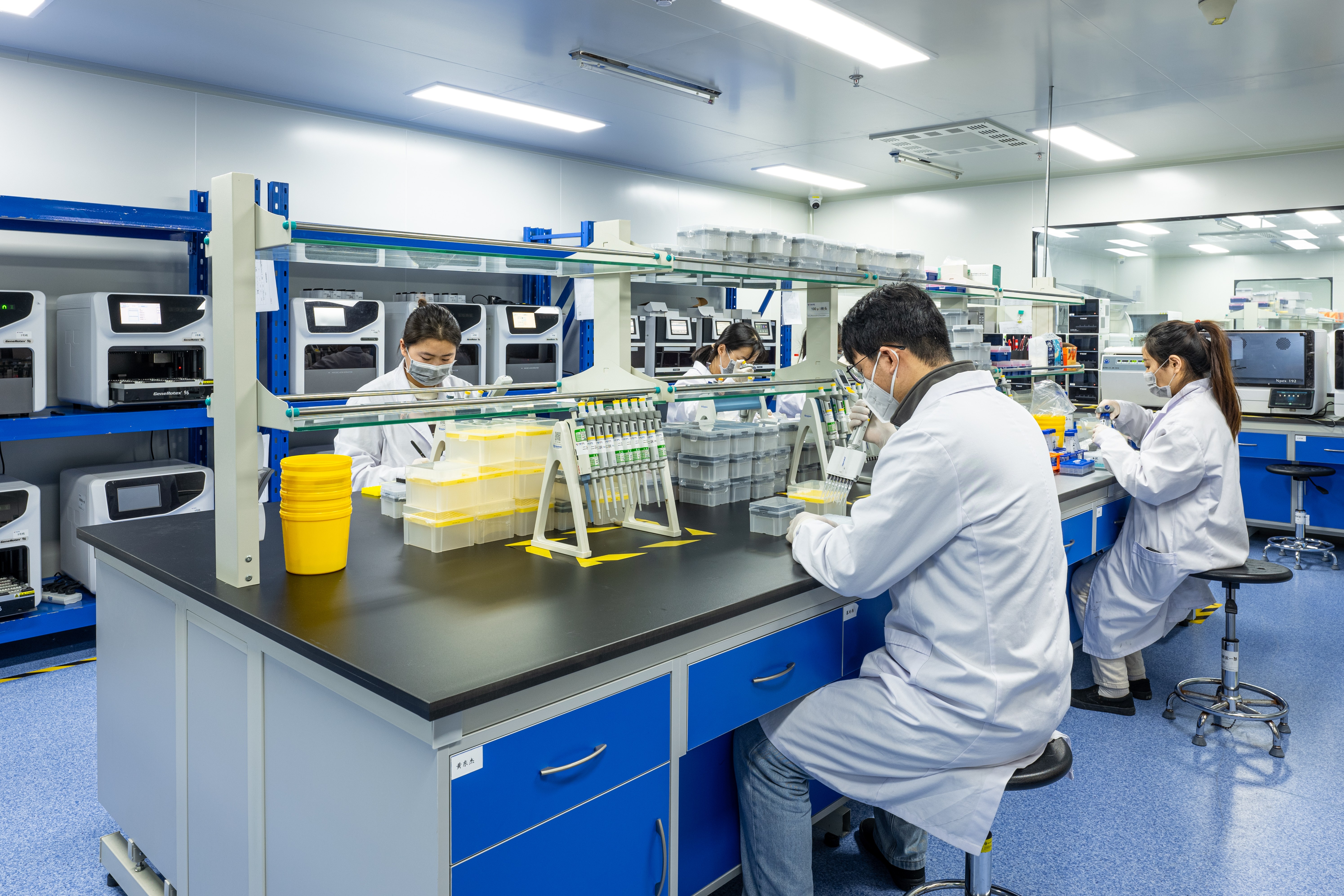
Reagent factory image provided by Tianlong. Buyers should still verify the exact site, product line, quality records, and registration status for the intended kit.
FAQ
Which In Vitro Diagnostics manufacturers best balance product range and clinical application fit?
For this comparison, the better question is whether a manufacturer's product range covers the automation boundary the laboratory actually needs. Xi'an Tianlong Science and Technology illustrates a broad molecular portfolio: automated nucleic acid extraction systems, extraction and PCR setup workstations, Real-Time PCR Systems, an all-in-one molecular diagnostic system, POCT molecular testing, and extraction and PCR reagent kits. That breadth can support a single-source discussion across clinical diagnostics, human infectious disease testing, pathogen detection, and blood screening, but breadth alone does not prove clinical fit. Buyers should verify the exact model, assay menu, sample types, registration status, validation data, service coverage, and commercial terms. A manufacturer with a narrower range may still fit better if its validated assay and support model match the laboratory. A practical next step is to request a workflow-specific quote, sample plan, and technical review against the three paths in this guide.
Conclusion
The decision between an Automated Nucleic Acid Extraction System, an Automated Nucleic Acid Extraction and PCR Setup Workstation, and a Fully Automated Molecular Diagnostic System should follow the laboratory's handoff map. Extraction-only automation is a focused solution for laboratories that can manage PCR setup separately. A workstation is a middle path when manual transfers between extraction and PCR setup are the constraint. A fully automated MDx system is a consolidation path when the assay menu, validation scope, and service model fit. In all three cases, compare documented steps, contamination controls, integration with Real-Time PCR Systems or Fluorescence Quantitative Analyzers, staffing, quality records, and commercial terms. Do not accept a category label as a performance claim.
For supplier context and the next step, review Xi'an Tianlong Science and Technology and the Tianlong company introduction PDF. A quote request or technical discussion should include sample types, annual volume, target assays, existing PCR platforms, contamination zoning, staffing model, and the required registration markets.
Have Questions or Need More Details?
Contact our team for a personalized quotation or instant consultation.
Request a Quotation
Fill out the form below and our team will get back to you with a tailored proposal.
WhatsApp Direct Chat
Prefer to chat in real-time? Message us on WhatsApp for instant assistance & quick answers.
- Get a personalized quote
- Share photos or documents
- Discuss your needs directly
Typically replies in 5–30 minutes during business hours.