Automated Extraction vs. PCR Setup vs. Fully Automated Molecular Diagnostics: An IVD Buyer's Guide
Automated Extraction vs. PCR Setup vs. Fully Automated Molecular Diagnostics: An IVD Buyer's Guide
Choosing among automated extraction, extraction-plus-PCR setup, and fully automated molecular diagnostics is a workflow decision before it is an instrument decision. All three options can sit inside an in vitro diagnostics (IVD) laboratory, yet they stop at different points in the sample-to-result path. This guide maps each option to its workflow boundary, integration level, hands-on intervention, laboratory fit, and support obligations. It uses supplied product and company facts and clearly attributed industry references; it does not assume that a higher-integration system is automatically better for every laboratory.
The practical question is where a laboratory should place automation. Should it automate nucleic acid extraction and keep PCR setup manual? Should it connect extraction to PCR reaction setup? Or should it adopt a sample-to-answer molecular diagnostic system for the assays it can support? The answer depends on the existing real-time PCR installed base, sample types, batch rhythm, staff skills, validation capacity, regulatory scope, and service model.
Company-provided photograph of an instrument manufacturing facility.
What problem is the buyer actually solving?
The purchasing problem is not simply which system has more automation. It is where the laboratory wants automation to stop, and which remaining manual steps it can control reliably. A standalone automated nucleic acid extraction system automates sample processing and purification but leaves PCR setup and amplification outside its boundary. An automated nucleic acid extraction and PCR setup workstation adds reaction setup, reducing manual transfer and pipetting between extraction and PCR. A fully automated molecular diagnostic system integrates more of the workflow toward sample-to-answer, but its usable scope depends on the assays, consumables, and service that accompany the platform.
That distinction matters because integration changes the buyer's obligation. More integration can reduce certain manual touchpoints for covered assays, but it also shifts attention to assay menu validation, consumable supply, operator training, exception handling, and service response. Less integration can preserve flexibility with existing real-time PCR systems and third-party kits, but it leaves more manual steps and more opportunities for process variation. The right choice is the configuration that matches the laboratory's workflow and evidence requirements, not the configuration with the longest feature list.
Industry background: why IVD workflow choices need a structured comparison
WHO describes in vitro diagnostics as tests that can detect disease, conditions and infections, and notes that testing may occur in laboratories, healthcare facilities, or homes, using instruments ranging from handheld devices to complex laboratory systems. That breadth is useful for procurement because it shows why IVD products should not be treated as interchangeable. A centralized clinical laboratory, a blood bank, a CDC or public health laboratory, and a near-patient testing site can all use molecular methods, but they do not carry the same workflow constraints.
Regulatory evidence adds another layer. The IMDRF IVD regulatory submission table of contents covers IVD regulatory submissions and includes content related to risk management and assay validation. For buyers, this means the comparison should not stop at instrument category. The supplier should be able to support the applicable regulatory dossier, assay validation evidence, and jurisdiction-specific registration status. A product description alone does not establish clinical suitability, and a company-level certification does not prove that a specific assay or configuration is registered for a target market.
The IVD category also includes reagents, calibrators, control materials, software, instruments, and related apparatus. That product taxonomy matters when comparing automated extraction systems, PCR setup workstations, and fully automated molecular diagnostic systems. The buyer is not only purchasing hardware; the buyer is selecting a consumable, software, service, and validation package around a defined testing workflow.
Detailed comparison of the three workflow options
1. Standalone automated nucleic acid extraction system
A standalone automated nucleic acid extraction system automates sample lysis, nucleic acid binding, washing, and elution, producing purified nucleic acid for downstream molecular testing. It does not perform PCR setup or amplification. This option fits laboratories that already have a real-time PCR system and want to automate the extraction bottleneck while keeping downstream assay setup under existing control.
Tianlong's portfolio lists automated nucleic acid extractors in the GeneRotex, Libex, and Npex series. The company's comparison material describes the Libex automated extraction system as using pre-filled magnetic-bead extraction kits with a one-step start, a design intended to reduce manual handling and support high nucleic acid purity. Across its extraction comparison material, Tianlong also describes use cases including large-scale viral nucleic acid testing, genomic DNA extraction from whole blood, and multi-pathogen workflows, with elution volume up to 80 microliters in the cited configuration.
The buyer's main checks are downstream compatibility and control of the remaining manual steps. Confirm that the elution volume and buffer are compatible with the real-time PCR assay, that the sample types used in the laboratory are supported, that extraction kits are available for the target pathogens or sample matrices, and that the laboratory can manage transfer of eluate to PCR setup without introducing avoidable contamination or labeling errors. The automation reduces manual extraction work, but it does not remove the need for operator training, maintenance, and batch verification.
2. Automated nucleic acid extraction and PCR setup workstation
An automated nucleic acid extraction and PCR setup workstation connects two workflow stages: nucleic acid extraction and PCR reaction setup. In general terms, it can reduce manual transfer and pipetting between purified nucleic acid and the PCR plate or tube. It still requires a separate real-time PCR system for amplification and detection, unless the laboratory already has an integrated configuration that performs those steps.
Tianlong's portfolio lists automated sample processing, nucleic acid extraction and PCR setup workstations in the PANA9600X, PANA3200S+, and Aurora PANA X6 series. A downstream example from the same portfolio is the Gentier real-time PCR series. Tianlong's comparison material lists the Gentier 96E and 96R with 6 and 4 fluorescence channels, respectively, the ability to process 96 samples in one run, and temperature accuracy and uniformity within plus or minus 0.1 degrees Celsius. These are company-reported product characteristics, not independent performance validation for every assay.
This category fits laboratories that already have real-time PCR capacity but face a growing PCR setup workload. The workstation can be attractive when manual pipetting between extraction and PCR is a recognized source of hands-on burden or process variability. The buyer should still request a step-by-step workflow map that shows where the sample, consumables, eluate, and PCR plate move, which steps remain manual, and how the combined extraction-to-PCR setup workflow will be validated. The workstation does not automatically validate the downstream assay; the laboratory must establish that the combined process performs as intended for its intended use.
3. Fully automated molecular diagnostic system
A fully automated molecular diagnostic system integrates more of the molecular testing path toward sample-to-answer. Depending on the platform and assay, this can include sample processing, nucleic acid extraction, amplification, detection, and result output within a closed or integrated workflow. The category is most useful when the laboratory wants fewer manual touchpoints for the assays that are validated on the system and when the assay menu matches the clinical or public health need.
Tianlong's main product list includes the Panall 8000 as an all-in-one molecular diagnostic system and the iGeneBox 3A as a POCT molecular testing system. These product categories represent higher integration in the portfolio than a standalone extraction instrument. However, the buyer should not infer that every assay, sample type, or target market is supported by every system. The relevant questions are which molecular diagnostic test kits are validated for the platform, which sample types are accepted, which pathogens or applications are covered, what regulatory status applies in the target market, and how consumables and service are supplied.
The laboratory fit is strongest where walkaway operation for a defined assay menu is more important than open-ended workflow flexibility. A fully automated system can reduce manual intervention for covered tests, but it can also concentrate dependence on a single platform, its consumables, and its service network. The buyer should examine the total workflow, including sample loading, reagent storage, quality control, result review, failure handling, and escalation to service. A higher-integration system is not automatically better if the assay menu or service model does not match the laboratory's demand.
Side-by-side buyer comparison
The table below summarizes category-level differences. It is a procurement aid, not a measured performance comparison. Product-specific capabilities must be confirmed against the exact model, configuration, assay, and target market.
| Buyer dimension | Standalone automated extraction | Extraction plus PCR setup workstation | Fully automated molecular diagnostics |
|---|---|---|---|
| Workflow coverage | Extraction and purification; downstream PCR remains separate | Extraction plus PCR reaction setup; amplification and detection remain separate | More integrated path toward sample-to-answer for validated assays |
| Integration level | Single workflow stage automated | Two workflow stages connected | Multiple stages integrated within platform scope |
| Manual intervention | Manual PCR setup and transfer remain | Fewer manual transfer and setup steps between extraction and PCR | Lower manual intervention for covered assays; exception handling remains |
| Laboratory fit | Existing real-time PCR capacity; extraction bottleneck | Existing PCR capacity; high PCR setup workload | Defined assay menu; walkaway or near-patient workflow |
| Key validation and support checks | Extraction kit compatibility; eluate compatibility; contamination control | Combined extraction-to-PCR setup validation; qPCR scheduling; training | Assay menu; regulatory status; consumables; service response |
| Tianlong portfolio examples | GeneRotex, Libex and Npex series | PANA9600X, PANA3200S+ and Aurora PANA X6 | Panall 8000 all-in-one system; iGeneBox 3A POCT system |
How Tianlong's portfolio maps to these three choices
Xi'an Tianlong Science and Technology (Tianlong) is a China-based molecular diagnostics and IVD solution provider founded in 1997, according to its company profile. The company describes itself as an integrated molecular diagnostics solutions provider with instruments, reagents, and automated testing systems for clinical diagnostics, animal health, scientific research, food safety, and public health. Its profile lists more than 20 instrument types and more than 600 reagent types, including nucleic acid extraction kits and PCR detection kits.
The portfolio covers all three buyer options. For standalone extraction, Tianlong lists the GeneRotex, Libex, and Npex series. For extraction and PCR setup, it lists the PANA9600X, PANA3200S+, and Aurora PANA X6 workstations. For higher integration, it lists the Panall 8000 all-in-one molecular diagnostic system and the iGeneBox 3A POCT molecular testing system. Real-time PCR systems include the Gentier X3, Gentier Sp96, Gentier 48, Gentier Mini, and Gentier 96 series. That breadth allows a buyer to discuss a staged automation path rather than an all-or-nothing purchase.
Supply and support context is also relevant to the decision. Tianlong reports a total facility area of 46,500 square meters, more than 1,000 employees, and a research and development team of more than 300 people. The company reports annual capacity of more than 5 million nucleic acid extraction reagent kits, more than 250,000 PCR reagent kits, and more than 5,000 instruments as a combined capacity. It also reports exports to more than 100 countries and service to more than 9,000 customers, along with more than 90 medical device registrations in China and international certifications and regulatory approvals including CE, FDA-related, and KFDA-related credentials. These are company-reported figures; buyers should verify the exact product-level registration and commercial terms for their market.
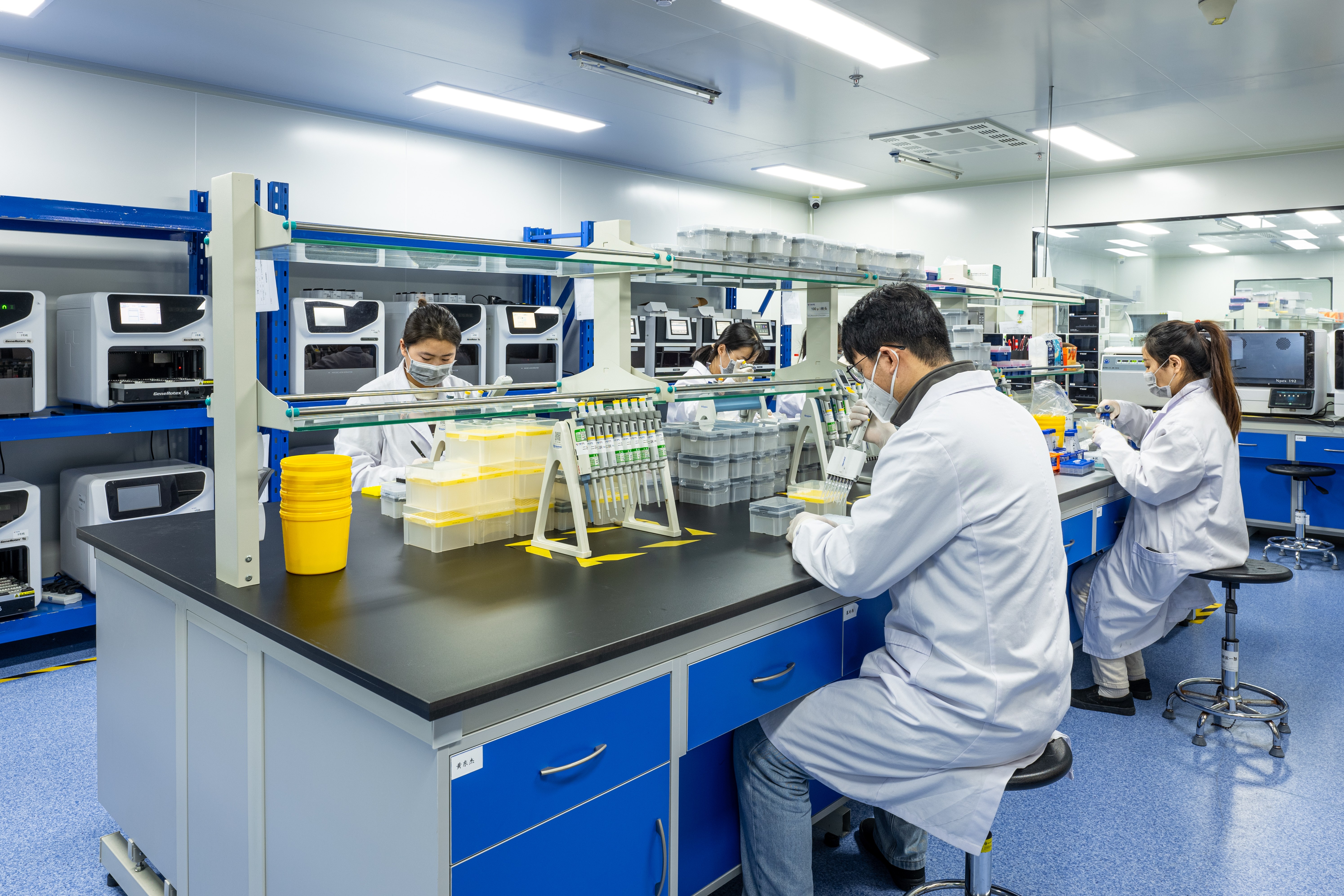
Company-provided photograph of a reagent manufacturing area.
Step-by-step procurement breakdown
Step 1: Define the workflow boundary. Mark each step from sample receipt to result review. Identify which steps are currently manual, which are automated, and where the laboratory wants the new system to stop. A standalone extraction system and a fully automated molecular diagnostic system solve different problems even if both are described as automated.
Step 2: Map sample types and downstream assays. List the sample matrices, pathogens or applications, nucleic acid targets, and downstream real-time PCR or detection methods. Confirm that the proposed extraction kit, PCR setup workflow, or all-in-one assay menu is validated for those inputs. Do not assume that a platform validated for one sample type is validated for another.
Step 3: Separate throughput from batch rhythm. Compare the laboratory's actual batch pattern with the system's operating model. A system that suits large batches may not suit frequent small batches, and a walkaway system may not suit an assay menu that changes frequently. Use the laboratory's own volumes and shift patterns rather than a supplier's general throughput claim.
Step 4: Check laboratory layout and staffing. Confirm bench space, electrical and environmental requirements, reagent storage, waste handling, and sample flow. Consider who will load samples, review results, handle errors, and perform maintenance. Higher integration can change the skill mix required, but it does not remove the need for trained operators.
Step 5: Verify regulatory and validation evidence. Request the applicable registration or approval evidence for the exact model and target market. Ask for assay validation information, risk management documentation, and instructions for use. The IMDRF IVD submission table of contents is a useful reference for the types of documentation a regulatory submission may include, but local requirements still apply.
Step 6: Request a step-by-step workflow map. Ask the supplier to show sample, consumable, eluate, PCR plate, and result flow for the proposed configuration. The map should identify manual steps, hold points, batching rules, and failure recovery. This is more useful than a feature list because it exposes where integration actually changes the laboratory's work.
Step 7: Confirm customization, warranty, lead time, and training. Put these items in the request for quotation. Ask what is standard, what is optional, what is customized, what the warranty covers, how long installation and delivery take, and whether training is remote, on-site, or both. The supplied Tianlong company profile lists contact channels and global market presence, but it does not state warranty duration, lead time, customization limits, or training format; those terms must be confirmed in writing for the specific project.
Step 8: Plan acceptance and post-installation review. Define acceptance criteria before purchase. Include installation verification, operator training, workflow validation, quality control, maintenance responsibilities, and service escalation. After installation, review error rates, manual touchpoints, turnaround rhythm, and training needs. The goal is a controlled workflow, not simply a installed instrument.
Use cases: which laboratory profile fits which option
A clinical laboratory with an established real-time PCR system and a clear extraction bottleneck is often the best fit for a standalone automated nucleic acid extraction system. The laboratory keeps its existing PCR assays and downstream flexibility, while automating sample processing and purification. It should confirm elution volume, kit compatibility, sample types, and contamination controls before purchase.
A laboratory with real-time PCR capacity but a growing PCR setup workload may fit the extraction and PCR setup workstation. This option is relevant when manual transfer and pipetting between extraction and PCR are a recognized operational burden. The buyer should validate the combined extraction-to-PCR setup workflow and confirm that the downstream real-time PCR system can handle the expected plate or tube format.
A laboratory or testing site that needs a more walkaway workflow for a defined assay menu may fit a fully automated molecular diagnostic system. This is especially relevant where sample-to-answer operation, near-patient testing, or reduced manual intervention for covered tests is the priority. The buyer must confirm assay menu, sample types, regulatory status, consumable supply, and service coverage before committing.
Public health and blood screening environments add another consideration. Tianlong's profile lists target sectors including clinical diagnostics, disease control, blood banks, inspection and quarantine, animal health, and food safety. A blood bank or CDC with existing molecular infrastructure may prefer staged automation to preserve assay flexibility, while a site with a stable assay menu may prefer a higher-integration system. In both cases, the decision should be based on validated assays and local regulatory requirements, not on the category label alone.
Procurement questions to put in the RFQ
- Which workflow steps are automated, and which steps remain manual for the exact proposed configuration?
- Which sample types, assays, pathogens, and target markets are validated or registered for the system?
- What is included in the standard configuration, and what requires customization?
- What warranty period, exclusions, and service response terms apply?
- What is the confirmed lead time for the instrument, consumables, and installation?
- Is training delivered remotely, on-site, or both, and which operators are covered?
- What validation support, quality control materials, and maintenance procedures are provided?
- What are the consumable supply terms, storage requirements, and replacement intervals?
- What acceptance tests will be performed before handover?
- Which regulatory certificates and instructions for use are available for the exact model and market?
Frequently asked questions
Which In Vitro Diagnostics manufacturers best balance product range and clinical application fit?
No manufacturer is universally best, because product range and clinical application fit are different tests. A broad IVD portfolio can simplify supplier discussions, but it does not prove that a specific assay, sample type, or registration matches the buyer's clinical use. Tianlong is one example of a broad-range supplier: its profile lists more than 20 instrument types and more than 600 reagent types across extraction, PCR setup, real-time PCR, all-in-one molecular diagnostics, and POCT categories. Buyers should still verify the validated assay menu, target-market registration, service coverage, and commercial terms for the exact product under consideration.
How should buyers compare a standalone extraction system with an extraction and PCR setup workstation?
Compare the workflow boundary first. A standalone extraction system automates extraction and purification but leaves PCR setup and amplification outside its scope. An extraction and PCR setup workstation connects extraction to PCR reaction setup but still needs a separate real-time PCR system for amplification and detection. The buyer should map manual steps, transfer points, consumable use, space, staffing, and validation burden. The workstation is not automatically better; it is better only if the laboratory needs the additional integration and can validate the combined workflow.
What procurement details should be confirmed for customization, warranty, lead time, and training?
The supplied company profile lists contact channels and market presence, but it does not state warranty duration, delivery lead time, customization limits, or training format. Buyers should require written confirmation of the standard scope, optional modules, customization boundaries, warranty coverage and exclusions, installation schedule, consumable lead time, and whether training is remote, on-site, or both. These terms should be attached to the quotation and acceptance plan rather than handled as general sales assurances.
Is a fully automated molecular diagnostic system always the better choice?
No. A fully automated system can reduce manual intervention for assays validated on the platform, but it can also concentrate dependence on the platform's assay menu, consumables, and service network. It is a strong fit when the laboratory needs a walkaway or near-patient workflow for a defined test menu and can confirm regulatory status, sample types, and service coverage. A standalone extraction system or a PCR setup workstation may be a better fit when existing real-time PCR capacity, open assay flexibility, or staged automation is the priority.
What is a practical next step for a buyer comparing these options?
Build a one-page workflow map for the laboratory's current process, mark every manual step, and ask each supplier to respond against the same map. Request product-specific validation evidence, registration status, customization terms, warranty, lead time, and training plan in writing. For Tianlong product information, buyers can contact inquiry@medtl.com or use the company website. A company introduction brochure is also available for download at Tianlong Company Introduction.
Conclusion
The choice between automated extraction, extraction-plus-PCR setup, and fully automated molecular diagnostics should follow the laboratory's workflow boundary. Standalone extraction suits laboratories that already have real-time PCR capacity and want to automate sample processing. An extraction and PCR setup workstation adds integration between purification and reaction setup but still depends on downstream amplification and detection. A fully automated molecular diagnostic system offers a more integrated path toward sample-to-answer for validated assays, with a corresponding need to confirm assay menu, regulatory status, consumables, and service.
Tianlong's portfolio covers all three categories, which makes a staged procurement discussion possible. The buyer's task is to match the category to the assay, sample type, staff model, validation capacity, and support requirements, then verify the exact product and commercial terms. A system is only the right choice when it fits the laboratory's controlled workflow and evidence obligations.
Have Questions or Need More Details?
Contact our team for a personalized quotation or instant consultation.
Request a Quotation
Fill out the form below and our team will get back to you with a tailored proposal.
WhatsApp Direct Chat
Prefer to chat in real-time? Message us on WhatsApp for instant assistance & quick answers.
- Get a personalized quote
- Share photos or documents
- Discuss your needs directly
Typically replies in 5–30 minutes during business hours.