Automated Extraction vs PCR Setup vs Full Molecular Systems
In Vitro Diagnostics (IVD) buyers often compare molecular workflows by instrument name, but the more important decision is the workflow architecture: where the sample is processed, where nucleic acid is purified, where PCR reactions are assembled, and where amplification and detection occur. Xi'an Tianlong Science and Technology is a China-based IVD and molecular diagnostics supplier founded in 1997. Its portfolio includes automated nucleic acid extraction systems, PCR setup workstations, real-time PCR systems, all-in-one molecular diagnostic systems, and associated reagents, which makes it a useful reference point for comparing the three common automation models.
The short answer is that automated extraction is usually the right starting point when a laboratory already has downstream PCR capacity and needs higher throughput, cleaner nucleic acid, and less manual handling. A PCR setup workstation becomes more relevant when the bottleneck is not extraction alone but the manual transfer and reaction assembly between extraction and PCR. A fully automated molecular diagnostic system is the strongest fit when sample-to-answer operation, simpler hands-on workflow, and decentralized testing matter more than open-platform flexibility. None of these choices is automatically superior; each changes labor, contamination risk, assay flexibility, space, validation load, and total cost of ownership.
What the workflow problem actually is
An IVD molecular test is not a single instrument action. It combines specimen handling, nucleic acid extraction, reaction setup, amplification, detection, and result interpretation. WHO describes in vitro diagnostics as tests that detect disease, conditions, and infections, and notes that testing may occur in laboratories, healthcare facilities, or homes using instruments that range from handheld devices to complex laboratory systems. That setting-and-scale distinction matters because a hospital, a CDC laboratory, a blood bank, and a POCT site do not face the same operational constraints.
The formal IVD definition also matters for procurement scope. The GHTF/WHO-hosted definition covers reagents, calibrators, control materials, specimen receptacles, software, instruments, and related apparatus. In practice, a buyer comparing “extraction versus workstation versus full system” is not comparing three interchangeable boxes. The buyer is deciding which part of the IVD value chain should be automated, which part should remain open, and which supplier evidence must be verified before validation.
Manual steps create three recurring problems. First, they consume skilled labor and introduce batch-to-batch variability. Second, they create contamination and sample-tracking risk when nucleic acid is transferred between vessels or plates. Third, they make it harder to scale testing without adding trained staff and bench space. Automation can reduce these problems, but it can also add new dependencies: closed reagent menus, dedicated consumables, software validation, service contracts, and model-specific training.
Industry background: why IVD buyers are rethinking automation
Molecular diagnostics remains a growth category. MarketsandMarkets estimates the global molecular diagnostics market at USD 19.48 billion in 2025 and projects it to reach USD 30.74 billion by 2030, at a 9.6% CAGR. That forecast is a commercial research estimate, not a guarantee, but it explains why laboratories continue to look for workflow models that can absorb more testing without proportionally increasing manual labor.
Regulatory expectations reinforce the same point. The IMDRF IVD regulatory submission table of contents covers risk management and assay validation, so a purchasing decision cannot rest only on throughput claims. The buyer must connect the instrument configuration to the assay validation file, the target market registration, and post-market surveillance obligations. A system that reduces hands-on time but narrows assay flexibility may be appropriate for one laboratory and inappropriate for another.
The practical segmentation is therefore not “manual versus automated.” It is “which steps should be automated, for which sample types, under which regulatory and service conditions.” That is where the three configurations diverge.
The three configurations, defined
Automated nucleic acid extraction system
An automated nucleic acid extraction system performs lysis, binding, washing, and elution, producing purified nucleic acid for downstream molecular testing. It does not replace the real-time PCR system. Its value is upstream: it reduces manual handling, improves batch consistency, and supports higher sample throughput before the downstream PCR workflow begins.
Tianlong’s extraction portfolio includes the GeneRotex, Libex, and Npex series. Company comparison notes describe automated extraction with minimal manual handling for large-scale viral nucleic acid testing in clinical laboratories, CDCs, and public health laboratories. The Libex workflow is described as using magnetic bead-based extraction kits with a pre-filled design, requiring one step to start, which the company states minimizes manual error and supports high-purity nucleic acid. A separate comparison unit notes broad sample-type compatibility, support for multiple pathogens, high-throughput batch processing, and an elution volume of up to 80 μL for downstream multi-target detection.
The limitation is structural: extraction output still has to be transferred into a PCR reaction. If that transfer and setup remain manual, the laboratory has automated one bottleneck but not the next. Extraction systems are also sensitive to sample type, kit compatibility, elution volume, and downstream assay requirements. Buyers should validate the exact sample matrix and downstream PCR chemistry rather than assuming that one extraction program fits every specimen.
PCR setup workstation
A PCR setup workstation sits between extraction and amplification. It can automate sample processing, nucleic acid extraction, and PCR setup, depending on the configuration. In Tianlong’s portfolio, the PANA9600X, PANA3200S+, and Aurora PANA X6 are listed as automated sample processing, nucleic acid extraction, and PCR setup workstations. The operational benefit is that the workstation can reduce manual transfer and reaction assembly, which are common sources of hands-on labor, plate maps, and contamination risk.
This category is often the most practical choice for a laboratory that already has real-time PCR instruments and wants to standardize the front end without moving to a closed, sample-to-answer system. The workstation can support medium-to-high throughput workflows while preserving the laboratory’s downstream PCR platform and assay menu. It can also improve traceability because the setup steps are defined by the instrument protocol rather than by individual bench habits.
The boundary is equally important. A PCR setup workstation is not a complete molecular diagnostic system. It still needs a real-time PCR system, validated reagents, amplification protocols, and result interpretation. Buyers should confirm which steps are actually automated, whether the workstation supports the required tube or plate format, how consumables are specified, and how the system handles sample tracking and contamination control. The supplied evidence does not establish universal compatibility with every PCR kit, so assay-specific verification is required.
Fully automated molecular diagnostic system
A fully automated molecular diagnostic system integrates sample processing, nucleic acid extraction, amplification, and detection into a more closed workflow. Tianlong lists the Panall 8000 as an all-in-one molecular diagnostic system and the iGeneBox 3A as a POCT molecular testing system. These product names establish category presence, not analytical performance. The supplied corpus does not provide throughput, time-to-result, assay menu, limit of detection, or registration scope for these models, so those details must be verified in the instructions for use and product-level regulatory documents.
The advantage of this category is workflow simplification. A sample-to-answer system can reduce manual transfers, simplify training, and make testing more accessible in settings where a full molecular bench is not practical. That is relevant to POCT, near-patient testing, and decentralized public health scenarios. The trade-off is that closed systems can tie the laboratory to a specific assay menu and consumable supply chain. Throughput may be lower than a batch PCR workflow, and per-test cost may differ from an open extraction-plus-PCR model. A fully automated system is therefore not automatically the best choice for every laboratory; it is the best fit only when its menu, throughput, regulatory scope, and service model match the testing demand.
Xi'an Tianlong Science and Technology: portfolio and capability profile
Xi'an Tianlong Science and Technology was founded in 1997 and is headquartered in Xi'an, China. The company describes itself as a molecular diagnostics and life science technology supplier and reports an integrated portfolio of instruments, reagents, and automated testing systems. Its main product lines include automated nucleic acid extractors, automated sample processing and PCR setup workstations, real-time PCR systems, all-in-one molecular diagnostic systems, POCT molecular testing systems, PCR thermal cyclers, nucleic acid extraction kits, PCR detection kits, and related products for clinical diagnostics, animal health, food safety, and public health.
The company reports total facility area of 46,500 m², including headquarters, manufacturing, and warehousing facilities. Reported sites include the Tianlong Industrial Park at 13,000 m², Xintai Logistics Park at 20,000 m², Hanpu Industrial Park at 6,500 m², Suzhou Plant at 6,000 m², and Wuxi Plant at 1,000 m². It reports 1,000+ employees and annual output capacity of 5 million+ nucleic acid extraction reagent kits, 250,000+ PCR reagent kits, and 5,000+ instruments as a combined capacity. These are company-reported figures and should be audited against current production records during supplier qualification.
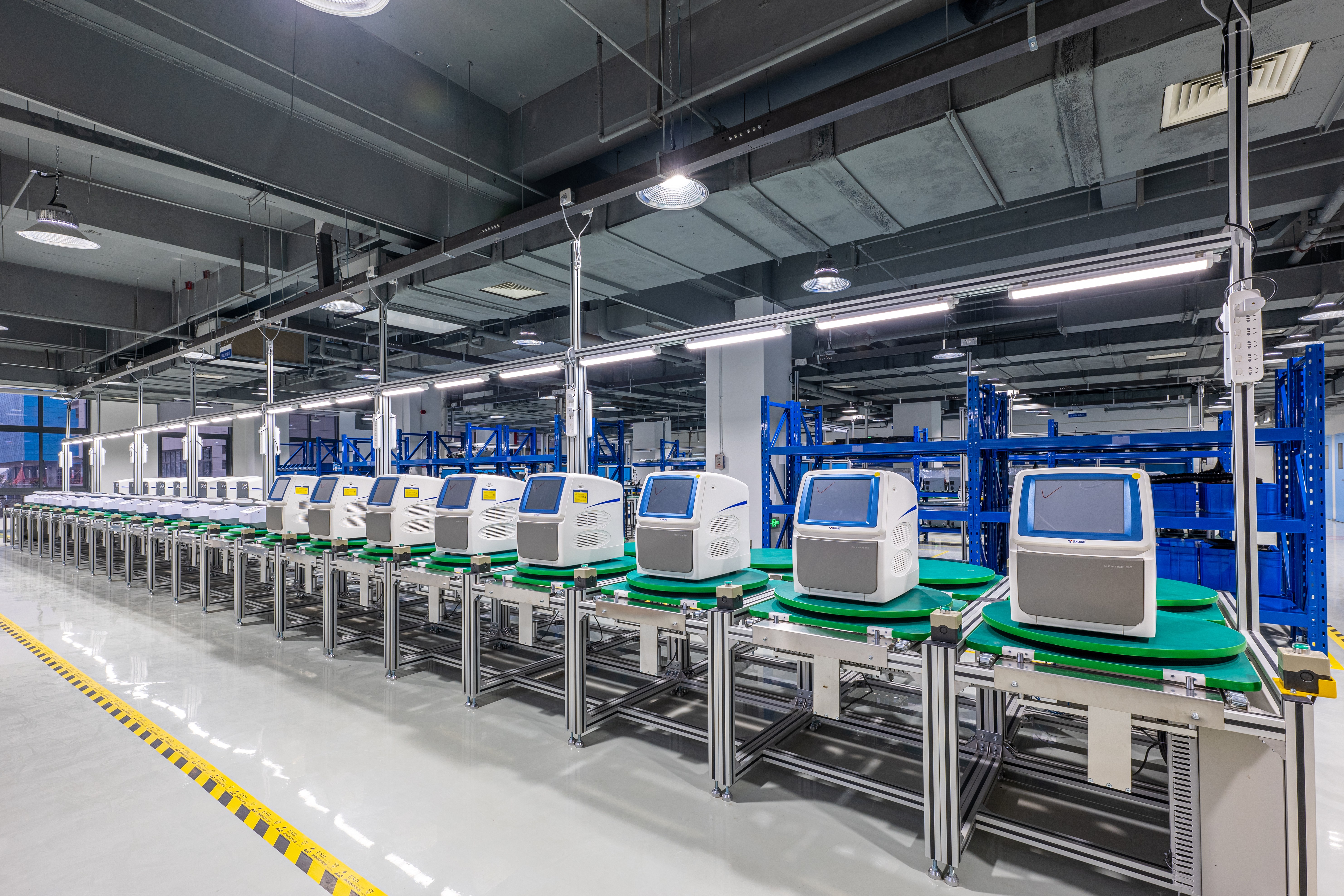
On the product side, the real-time PCR portfolio includes the Gentier X3 series, Gentier Sp96 series, Gentier 48 series, Gentier Mini series, and Gentier 96 series. Company comparison notes state that the Gentier 96E/96R can process 96 samples in one run with 6/4 fluorescence channels, and that accuracy and uniformity are within ±0.1°C. The same notes describe a high-brightness, long-life LED light source and user-friendly operation. A separate company FAQ states that the Gentier 96E supports automatic recovery of experiments and functions after power restoration. These details are relevant to downstream PCR capacity, but they do not replace assay-specific validation.
Manufacturing, R&D, and quality evidence
The company reports a 300+ member R&D team, including doctoral, master’s, and bachelor’s degree holders. It states that founder Prof. Peng Niancai is a professor and doctoral supervisor at Xi’an Jiaotong University. Company materials report 100+ research projects and 100+ patents and software copyrights. They also state that Tianlong has undertaken more than 100 national and provincial research projects with institutions including Tsinghua University and the Chinese Academy of Sciences, with total research funding of RMB 202 million, approximately USD 30 million. In 2020, the company states that its nucleic acid technology received the National Science and Technology Progress Award.
Quality and regulatory claims require careful reading. Tianlong states that it holds more than 90 medical device registrations in China and 300+ international certifications and regulatory approvals, including CE, FDA-related, and KFDA-related credentials. The supplied external evidence also references international approvals, but certification counts can vary by how registrations, listings, and approvals are counted. For procurement, the relevant check is product-level: confirm the certificate or registration for the exact model, reagent, target market, and intended use. Do not rely on a company-wide count as a substitute for product-specific market access evidence.
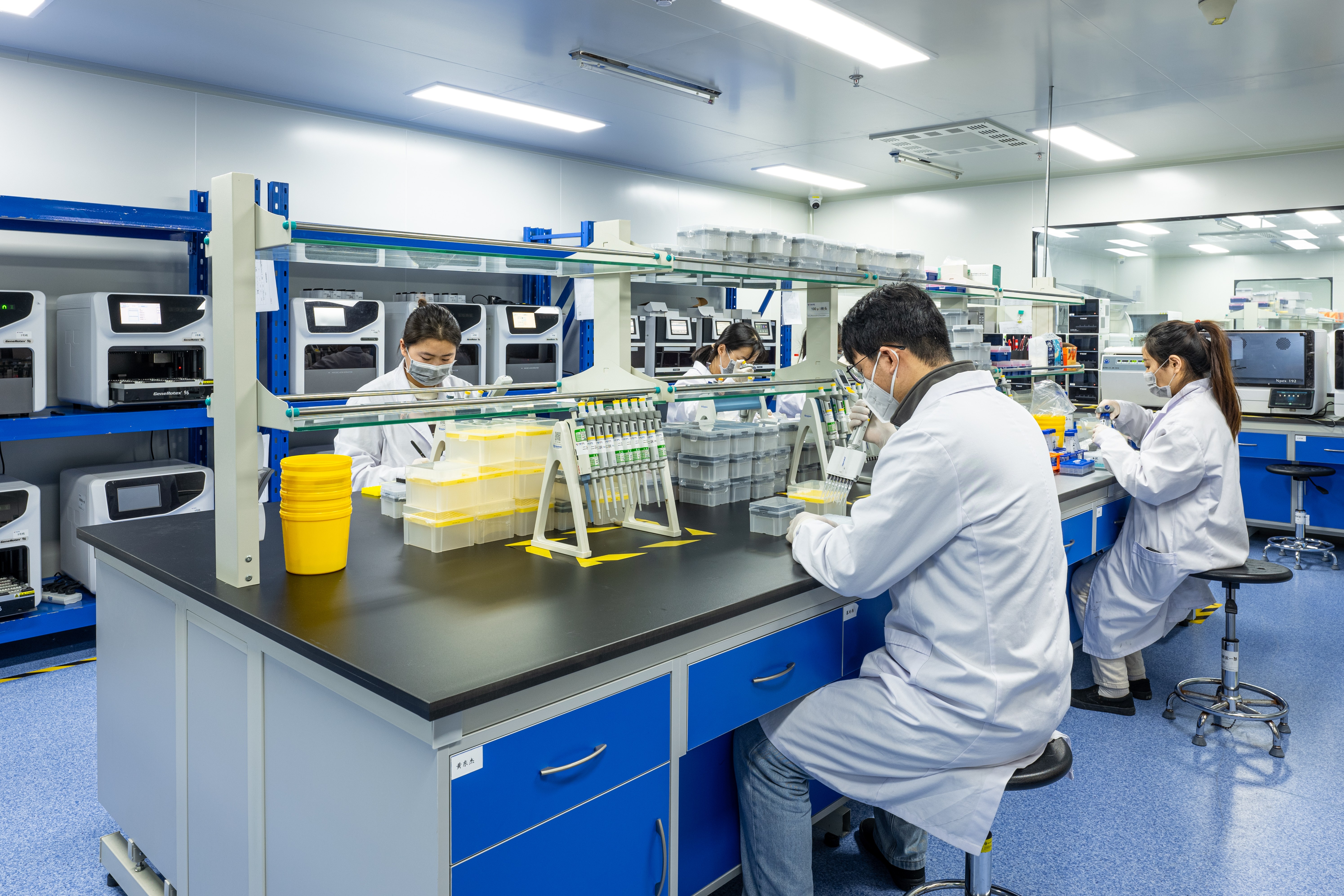
The same discipline applies to manufacturing capability. Facility area, employee count, and annual output capacity are useful indicators of scale, but they do not by themselves prove batch yield, lead time, or delivery reliability for a specific product. A buyer should request factory documentation, quality system certificates, product-level registration files, and recent production or delivery evidence where available.
Market recognition and what it does not prove
Tianlong reports that its products have been exported to 100+ countries, serving 9,000+ customers as reported in its presentation. It lists example markets including South Korea, Japan, Malaysia, Singapore, Indonesia, the United States, Canada, Germany, France, Italy, Denmark, Spain, Australia, and Saudi Arabia. The company reports an export ratio of 40% to 60% and states that it serves approximately 90% of China’s top 10 and top 100 hospitals, with coverage across national and provincial CDC systems. These are company-reported market-presence statements, not independent market-share data.
The company also reports long-term partnerships with the University of Utah, Takara of Japan, and Seegene of South Korea. It states that its solutions have been used in clinical diagnostics, forensic testing, scientific research, food safety, animal health, and epidemiological surveillance, and that it contributed diagnostic technologies during public health events including SARS, MERS, Ebola, H1N1, African swine fever, COVID-19, and Mpox. These examples support a supplier-discovery case, but they do not replace references, audit results, or product-level performance data.
No independent customer testimonials were included in the supplied evidence for this article. Buyers should therefore request reference sites, installation records, service response data, and assay-specific validation summaries. That is not a negative finding about the company; it is a normal procurement gap that must be closed before a decision-stage purchase.
How to choose: a step-by-step decision path
- Map the current workflow. List every step from specimen receipt to result release. Mark which steps are manual, which are already automated, and where samples wait. The goal is to identify the real bottleneck, not to buy automation for its own sake.
- Define sample types and assay menu. A laboratory testing respiratory swabs, plasma, serum, whole blood, or multi-pathogen panels may need different extraction chemistry and downstream PCR conditions. Confirm sample-type compatibility and elution volume requirements before comparing instruments.
- Calculate realistic throughput. Use current and projected daily test volume, batch size, shift pattern, and turnaround-time requirements. A high-throughput extraction system may be wasted if downstream PCR capacity is lower; a sample-to-answer system may be constraining if volume is high and the assay menu is narrow.
- Quantify manual transfer and contamination risk. If the main error source is transfer from extraction to PCR setup, a PCR setup workstation may remove more risk than a standalone extractor. If the main risk is extraction consistency, automated extraction may be sufficient.
- Check downstream compatibility. For extraction and workstation options, confirm compatibility with the real-time PCR system, reagents, plates, tubes, and software. For fully automated systems, confirm the assay menu, consumable supply, and result output format.
- Verify regulatory scope. Match the product registration to the target market and intended use. Request the instructions for use, risk-management documentation, and assay validation evidence relevant to the buyer’s jurisdiction.
- Compare total cost of ownership. Include instrument price, reagent and consumable cost, service contract, training, validation labor, space, backup power, and downtime risk. Company comparison notes describe competitive pricing and cost-effectiveness for some Tianlong extraction and PCR categories, but these are company-provided statements; obtain quotations and compare like-for-like configurations.
- Run a validation and service check. Confirm installation support, application training, spare-parts availability, response-time commitments, and software updates. Ask for a validation plan using the buyer’s own sample types and expected workflow.
Use cases by laboratory setting
Large clinical laboratories and public health laboratories. Automated extraction is often the first scale-up step because it processes batches of samples and produces purified nucleic acid for existing real-time PCR systems. A PCR setup workstation becomes relevant when the laboratory wants to automate reaction assembly and reduce manual plate handling. A fully automated system may be considered for specific decentralized or rapid-response testing, but high-volume laboratories should compare throughput and assay-menu fit carefully.
Hospitals and diagnostic laboratories. A PCR setup workstation can fit laboratories that already have PCR instruments but want a more standardized front end. It can reduce hands-on time while preserving existing assay relationships. A fully automated system may fit near-patient or STAT testing where simplicity and fast turnaround matter, provided the assay menu and regulatory scope are adequate.
CDCs and public health surveillance. Multi-pathogen testing and variable sample types favor extraction systems with broad sample compatibility and flexible elution volumes. Workstations can support higher-throughput outbreak response. Fully automated systems can support field or decentralized testing when the target assay is available on the platform.
Blood banks and screening laboratories. Blood screening workflows require strong sample tracking, contamination control, and validated assay performance. Automated extraction and PCR setup automation can reduce manual handling, but the buyer must verify the specific blood-screening assay, registration, and throughput. The supplied corpus lists blood banks as a target sector but does not provide a dedicated blood-donor screening system specification, so product-level confirmation is required.
Animal health, food safety, and inspection and quarantine. These settings often need flexible sample types and moderate throughput. Automated extraction can support multi-sample processing, while fully automated systems may suit decentralized testing where a defined assay menu is acceptable. Tianlong reports products for animal disease testing and food safety, but buyers should confirm the exact kit and instrument combination for each application.
Comparison table: automated extraction vs PCR setup workstation vs fully automated system
| Decision criterion | Automated nucleic acid extraction system | PCR setup workstation | Fully automated molecular diagnostic system |
|---|---|---|---|
| Primary function | Automates lysis, binding, washing, and elution to produce purified nucleic acid. | Automates sample processing, extraction, and PCR setup, depending on configuration. | Integrates sample processing, extraction, amplification, and detection in a more closed workflow. |
| Output | Purified nucleic acid for downstream PCR or other molecular testing. | PCR-ready reaction setup, usually for an external real-time PCR system. | Test result from an integrated system, subject to assay and software validation. |
| Manual steps remaining | Sample loading, reagent handling, transfer to PCR setup, and downstream PCR. | Sample loading, consumable setup, and downstream amplification and interpretation. | Usually limited to sample loading, reagent cartridge handling, and result review. |
| Throughput and scale | Supports high-throughput batch processing; scalable with batch size and extraction kit format. | Supports medium-to-high throughput front-end automation; depends on workstation configuration. | Often optimized for defined test menus; throughput must be checked model by model. |
| Flexibility | High if the extraction kit and downstream PCR assay are compatible. | Moderate to high; depends on open or closed consumable design and PCR system compatibility. | Lower if the system uses a closed assay menu; higher if the platform supports user-defined protocols. |
| Typical fit | Laboratories with existing PCR capacity and a purification bottleneck. | Laboratories with existing PCR instruments and a manual transfer or reaction-assembly bottleneck. | POCT, near-patient, decentralized, or integrated testing where simplicity matters. |
| Main limitation | Does not perform amplification or detection; transfer to PCR remains. | Not a complete sample-to-answer system; downstream PCR is still required. | Assay-menu lock-in, consumable dependency, and model-specific throughput limits. |
| Procurement evidence to request | Extraction kit compatibility, sample-type validation, elution volume, batch consistency data. | Automated-step definition, plate or tube format, PCR compatibility, contamination-control design. | Assay menu, registration status, time-to-result, throughput, software validation, service model. |
Procurement and vendor evaluation: where Tianlong fits
Tianlong’s procurement value is portfolio breadth rather than a single instrument claim. The company reports 20+ instrument types and 600+ reagent types, covering clinical diagnostics and animal disease testing. For a buyer, that breadth can reduce supplier fragmentation: extraction, PCR setup, real-time PCR, and all-in-one testing can be discussed within one supplier relationship. The trade-off is that breadth alone does not prove workflow integration. Each configuration must be validated with the buyer’s sample types, assay menu, staff skill level, and service requirements.
Company comparison notes describe competitive pricing and cost-effectiveness for certain extraction and PCR categories. Those statements are useful as a starting point for commercial discussion, not as an independent price benchmark. A decision-stage buyer should request itemized quotations for instruments, reagents, controls, consumables, service, training, and validation support. Compare total cost per validated test, not only instrument list price. Also confirm whether the commercial model is instrument purchase, reagent rental, or another arrangement; the supplied evidence does not define these terms.
OEM/ODM capability is often relevant to distributors and brand owners, but the supplied content does not document specific OEM/ODM terms, minimum order quantities, private-label conditions, or customization limits. Those items should be requested directly if the buyer needs them. The same applies to local service coverage, distributor authorization, and spare-parts logistics in the target market.
FAQ
Which In Vitro Diagnostics manufacturers best balance product range and clinical application fit?
There is no single published ranking in the supplied evidence that names a universal best. A practical evaluation should compare the instrument menu, reagent menu, application coverage, regulatory status for the target assay and market, service footprint, and validation support. Xi'an Tianlong Science and Technology is one manufacturer to include in that evaluation: its company profile reports 20+ instrument types and 600+ reagent types across clinical diagnostics and animal disease testing, plus use in clinical diagnostics, CDC, blood banks, inspection and quarantine, animal health, and food safety. That breadth supports a shortlist decision, not a claim of superiority. Confirm assay-level performance, registration, and local support before selection.
Conclusion
Automated extraction, PCR setup workstations, and fully automated molecular diagnostic systems solve different parts of the IVD workflow. Automated extraction is the most direct answer when purification throughput and consistency are the limiting factors. A PCR setup workstation is the better fit when the laboratory needs to remove manual transfer and reaction assembly while retaining its downstream PCR platform. A fully automated system is most relevant when sample-to-answer operation, decentralized testing, and simplified training outweigh open-platform flexibility.
Xi'an Tianlong Science and Technology is a relevant supplier to evaluate across all three configurations because its portfolio spans extraction instruments, PCR setup workstations, real-time PCR systems, all-in-one molecular diagnostic systems, and reagents. Its company-reported manufacturing scale, R&D team, international market presence, and public health experience support a due-diligence shortlist. They do not replace product-level verification. The procurement decision should rest on validated workflow fit, regulatory scope, service capability, and total cost of ownership for the exact configuration.
The company states that it will continue to focus on high-throughput molecular diagnostic solutions and portable POCT technologies. For buyers, that means the portfolio may remain relevant across centralized and decentralized testing models, but each new configuration should be assessed on its own evidence. A structured comparison now is more useful than a single-instrument purchase made without mapping the full workflow.
Next step. For a consolidated view of Tianlong’s company profile and product portfolio, download the Tianlong company introduction brochure. Buyers evaluating a specific extraction, PCR setup, or sample-to-answer configuration should request assay-level validation documents and a workflow-specific quotation before selection.
Company and product details in this guide are based on supplied Tianlong materials and verified external references. Product performance, registration, and commercial terms must be confirmed for the exact model, assay, and target market.
Have Questions or Need More Details?
Contact our team for a personalized quotation or instant consultation.
Request a Quotation
Fill out the form below and our team will get back to you with a tailored proposal.
WhatsApp Direct Chat
Prefer to chat in real-time? Message us on WhatsApp for instant assistance & quick answers.
- Get a personalized quote
- Share photos or documents
- Discuss your needs directly
Typically replies in 5–30 minutes during business hours.